Research
Overview
We conduct research in the fields of coastal engineering and physical coastal oceanography. Our research studies aim to improve the understanding and prediction of coastal hazards and processes by integrating theory, observations, and advanced computational modeling.
Our work mainly relies on state-of-the-art numerical models, including ADCIRC, SCHISM, SWAN, XBeach, SFINCS, among other models, to simulate coastal ocean dynamics, waves, storm surge, coastal flooding, and shoreline evolution. These physics-based models are complemented by statistical and AI approaches, which we develop to improve prediction, accelerate simulations, and extract insights from large datasets.
Our research spans various temporal and spatial scales - from storm- and street-level flood hazards in urban environments to climate- and basin-scale ocean processes - with the goal of advancing predictive capabilities and informing coastal hazard mitigation and adaptation.
Research Theme: Coastal Flood Risk
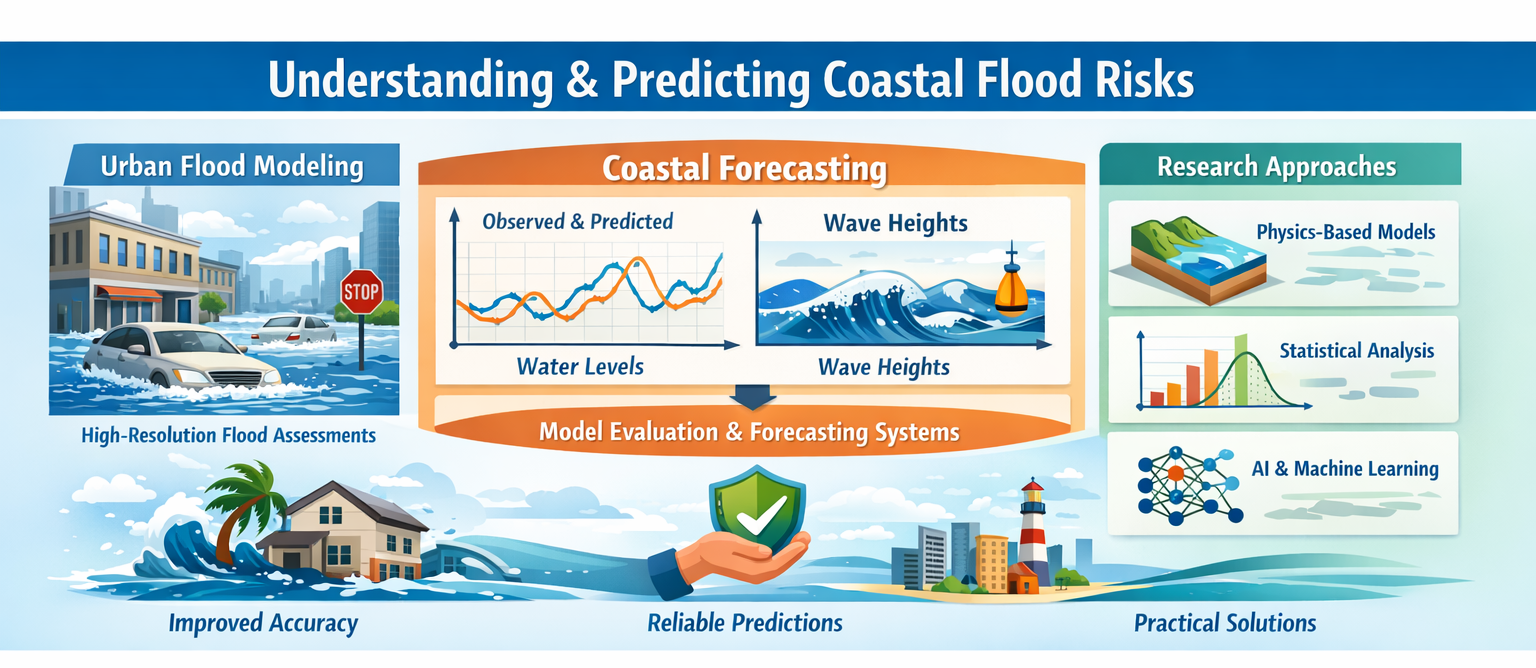
This research theme focuses on advancing the understanding and prediction of evolving coastal flood risks across a range of spatial and temporal scales. Our work includes high-resolution flood risk assessment in urban environments, such as street-scale modeling of coastal flooding in cities. We also investigate the predictive skill of coastal flood forecasting systems, evaluating the predictive skills of different models and forecasting frameworks for coastal water levels and waves. Through a combination of physics-based modeling, statistical analysis, and AI-driven approaches, our goal is to improve the accuracy, reliability, and practical utility of coastal flood predictions.
Research Theme: Nature-Based Solutions for Coastal Hazard Adaptation
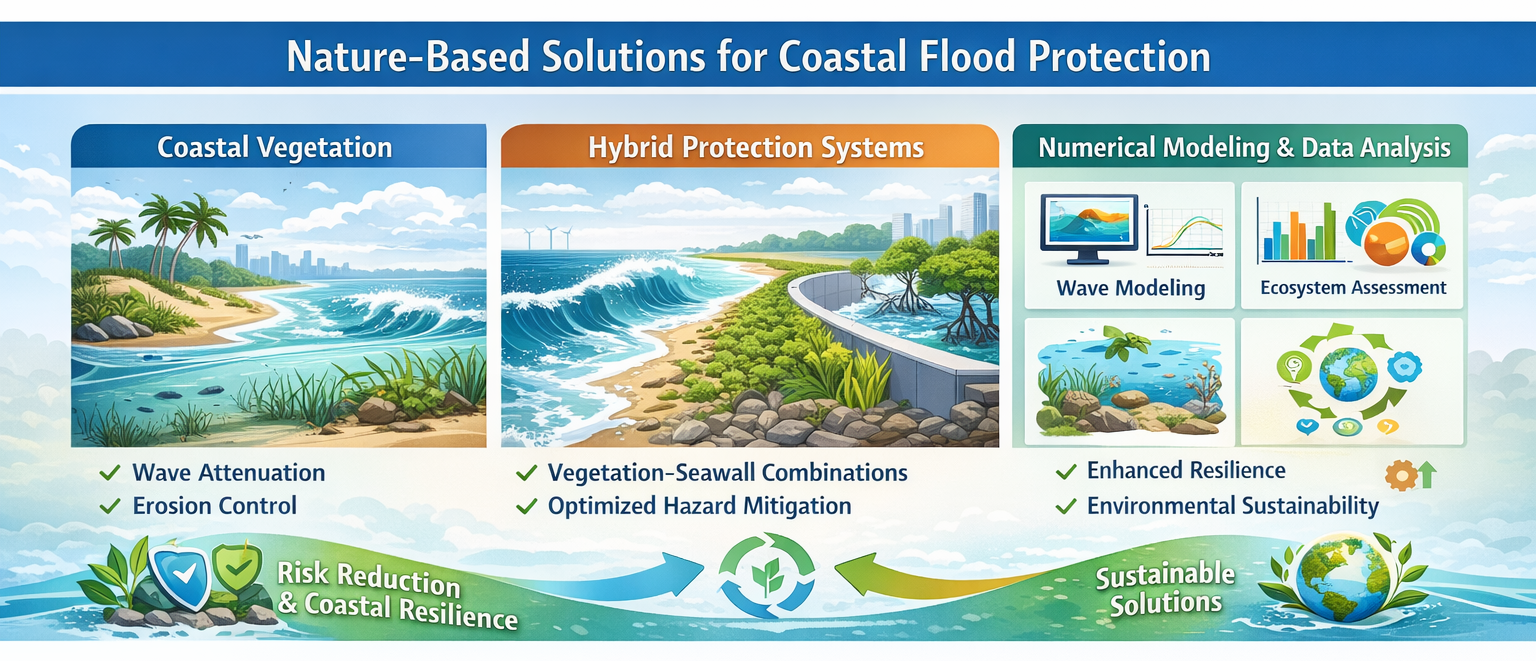
Nature-based solutions are increasingly recognized as an important strategy for mitigating coastal hazards. Our research examines the flood risk reduction performance of nature-based features, such as coastal vegetation, and explores how these natural elements interact with traditional engineered structures. We also investigate hybrid coastal protection systems, such as vegetation–seawall combinations, with the goal of optimizing their design for effective and efficient hazard mitigation. By combining numerical modeling with data analysis and optimization techniques, we seek to identify solutions that enhance coastal resilience while maintaining environmental sustainability.
Research Theme: Coastal Processes
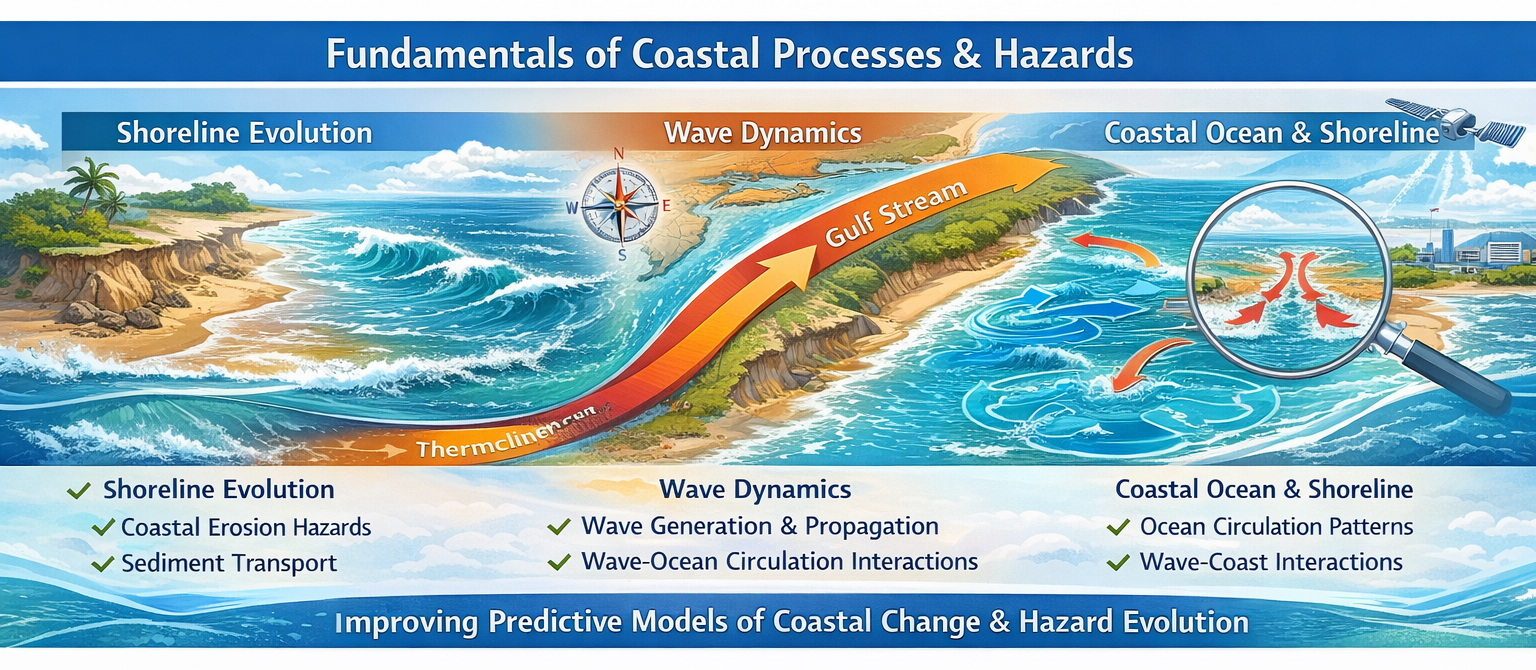
Understanding coastal hazards requires a strong foundation in the fundamental processes that shape the coastal ocean and shoreline. Our research investigates a range of coastal processes, including shoreline evolution, coastal erosion hazards, wave dynamics, and interactions between waves and ocean circulation. For example, we are interested in how large-scale ocean currents, such as the Gulf Stream, influence wave conditions and coastal hazards. By studying these processes across multiple spatial and temporal scales, we aim to improve predictive models of coastal change and hazard evolution.